Credit Policy Decisioning
Dead deals never reach your desk

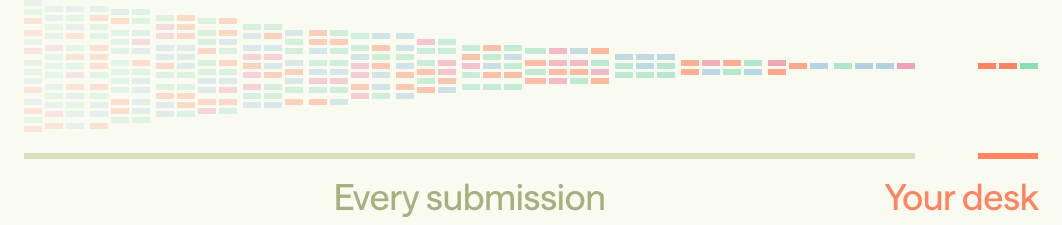







Every no costs as much as a yes
Underwriting cost is close to fixed per file, so the deal you decline costs about what the deal you fund costs. Every dead file is billed twice: once to look at it, and again in the deal you did not work instead.

You funded it
The read paid for itself.

You declined it
Same read, same hours, nothing back.

Every one of these was read end to end. The ones that came back a no took the same hours as the ones that funded.

Same read · Same hours · Nothing back
Every check returns pass, review, or decline
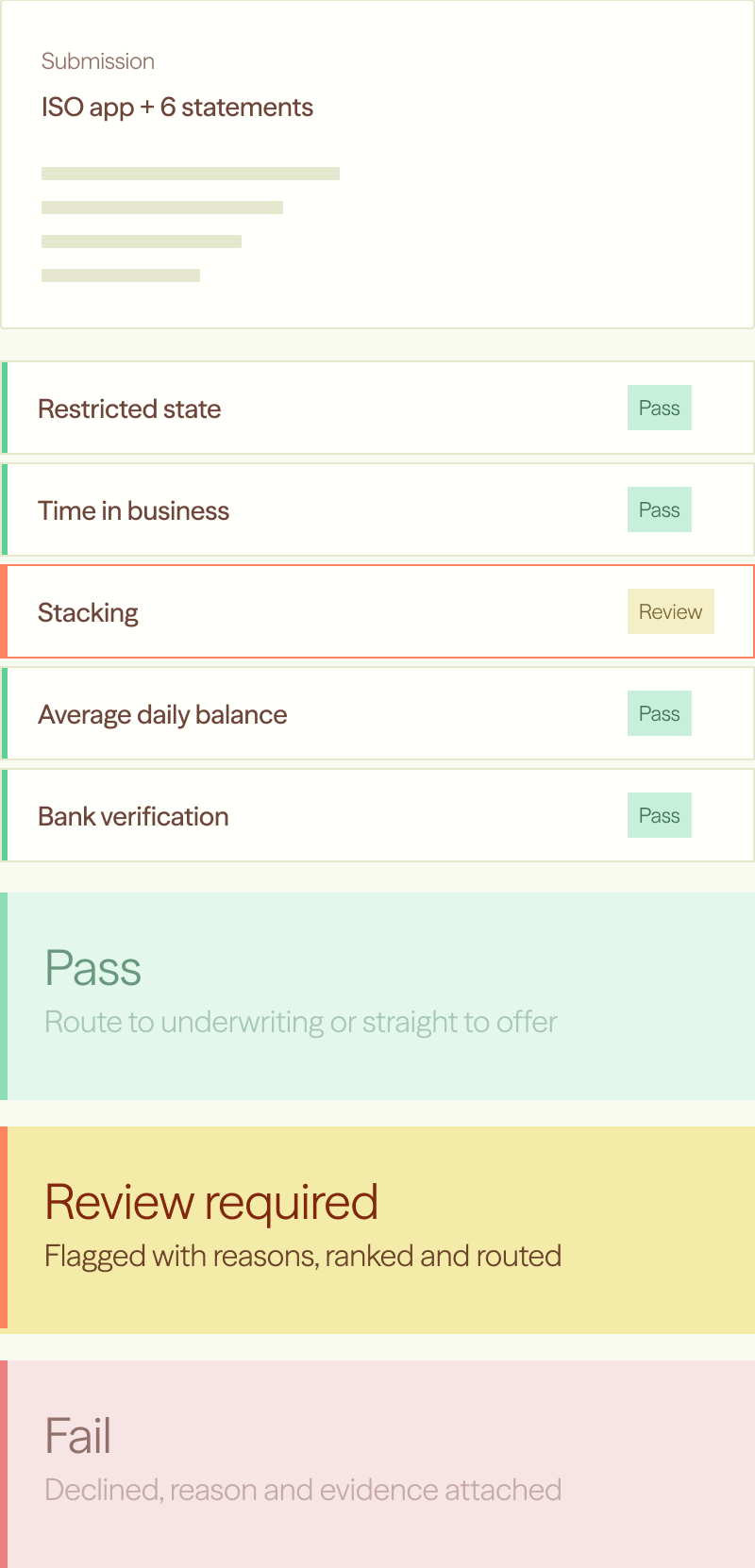
Pass routes to underwriting, review required carries its flags, and fail carries the reason and the evidence. When a check cannot be evaluated it routes to review, never to pass.
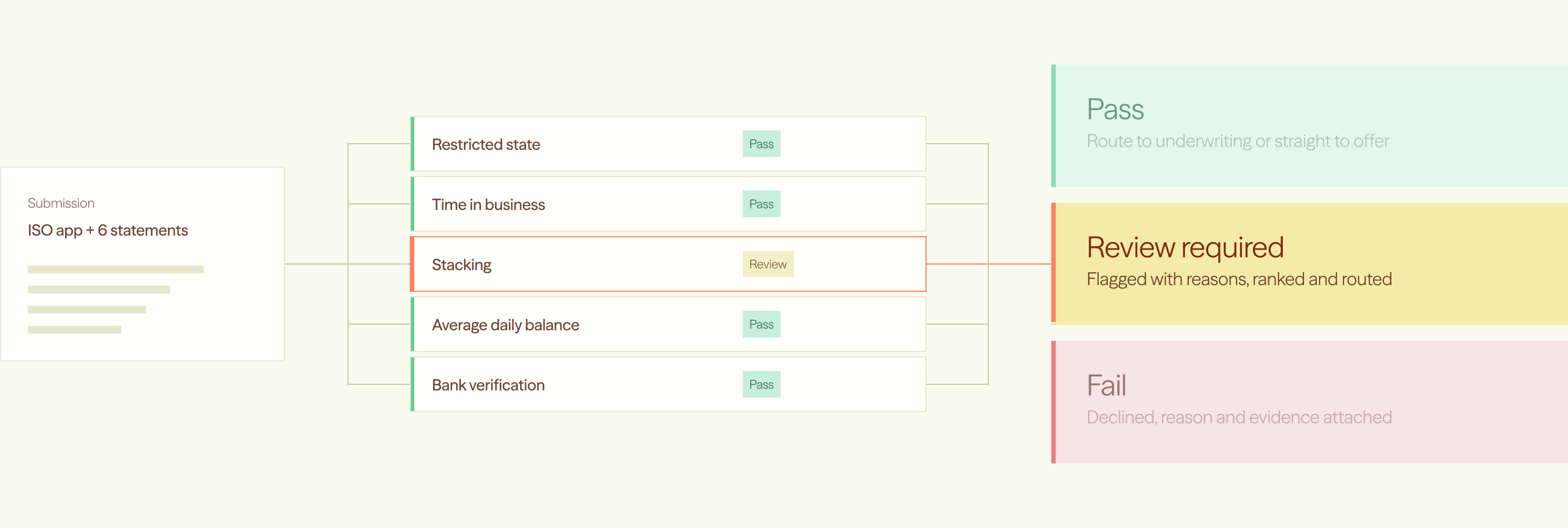
Every check runs in a testing period first, flagging what it would have declined instead of killing it. As you build trust in the calls, you promote them to auto-decline one at a time.
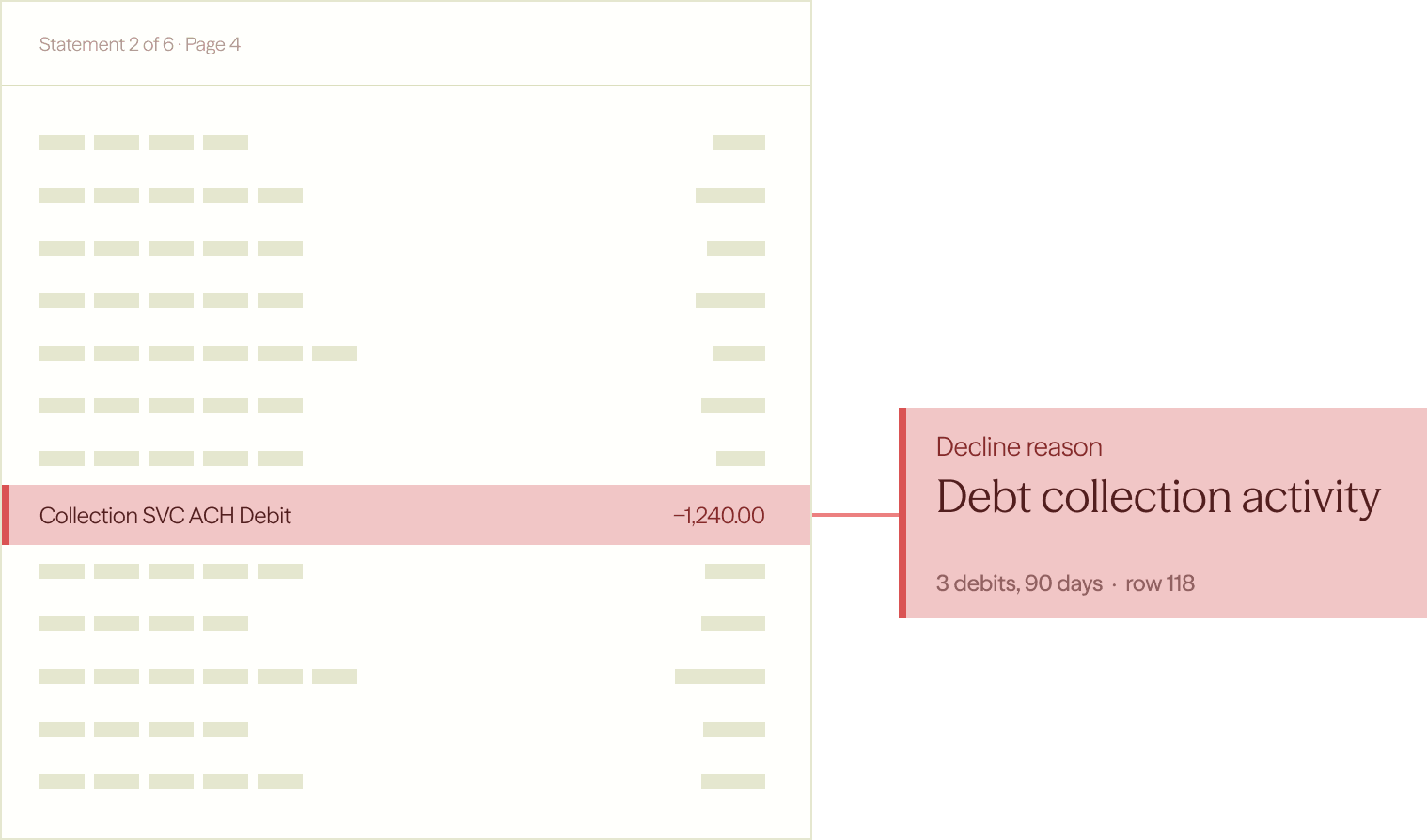
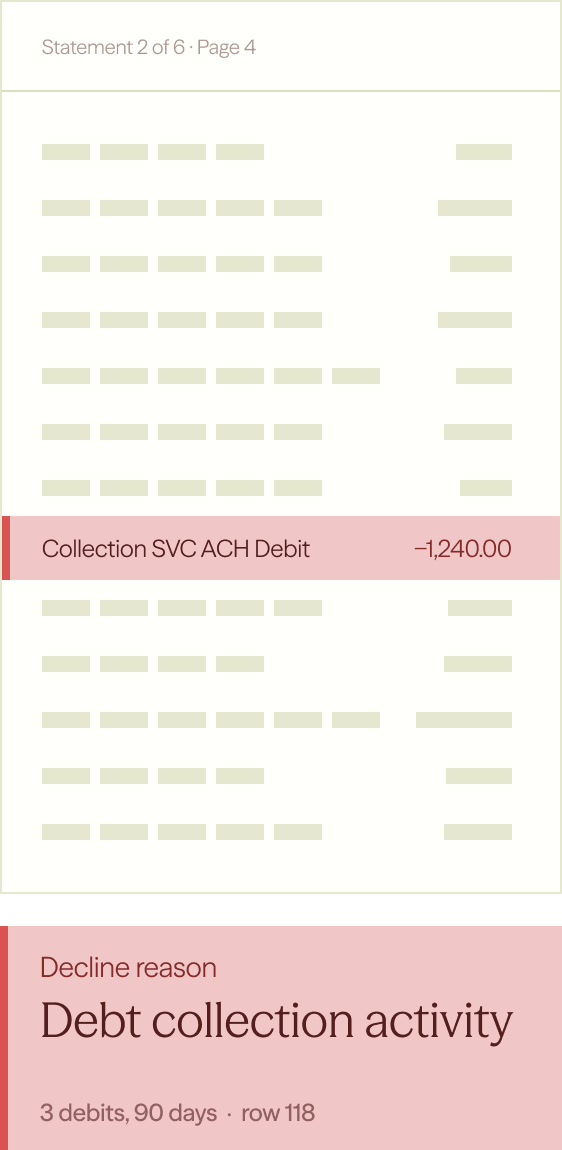
Every decline links to the record it came from
Every check result stores the value it tested, the document it came from, the section, and the rows. Open the decline reason and you land on the transaction that caused it.

The OCR piece is obviously valuable, but everybody does that. What made us choose Heron was its ability to plug directly into our intake workflow, automate submission processing, and integrate deeply with our underwriting system.
Decisions straight to where you already work
The call lands in the CRM your team already runs. Nobody opens a dashboard to find out what happened.
Everything between the submission and the offer
Purpose-built AI trained on more small business finance than anyone else sees — built for the people making real decisions on real businesses.


ISO Application Scrubbing
Every sub read and classified on arrival, with the fields your kick-outs run on lifted straight off the form: state, time in business, revenue, entity type.

Industry Prediction
The NAICS code taken off the transactions rather than the application, and checked against your own restricted list.

Cashflow Analytics
Bank statement analysis that reads real repayment capacity, with every position tracked from funded to paid off.

Fraud Detection
Doctored statements and coordinated patterns caught across applicants, not just on the file in front of you.

Background Checks
SOS filings, TIN/EIN validation, court records and web presence, run on the owner and the business together, with the verdict decided by your policies rather than ours.
Credit Policy Decisioning
Your rules on every deal, the reason attached, and the outcome synced straight into your CRM.
Heron saves a ton of time for our adjusters. These are highly analytical people, you want them using their brain for adjudication, not thinking about manually copying information.
We want this information on every deal...Heron is positioned at the top of our funnel because it's handling the most important data.

We're more consolidated and organised in the underwriting space now. And candidly — we're funding more deals.


We used to be online at 10 p.m. and work until 1 a.m. just entering applications. With Heron, we're finally out from behind the keyboard — we're meeting partners, traveling, growing the business. That just wasn't possible before.

An application comes in with bank statements. Nobody touches it. Heron automatically takes all that data, parses it, automatically sets up a contact record, an account record, and an opportunity in Salesforce. And then it automatically digitizes the statements.
We get an application emailed in, the statements go straight to Heron, and we do nothing else. Then the underwriter's got all the data they need to decide. It's the piece that kicks the whole process off...if you can't parse the bank info, you can't do anything else.
The OCR piece is obviously valuable, but everybody does that. What made us choose Heron was its ability to plug directly into our intake workflow, automate submission processing, and integrate deeply with our underwriting system.
Being able to automate bank statement scrubbing and structuring data allowed us to eliminate agents to about half of our total, and also to repurpose some agents in more verification roles, as opposed to doing this heavy manual lifting.
Heron is quite easily number one in importance for our tech stack...Realistically, you are not going to be able to put together an educated view of someone's account if you're only doing open banking-based underwriting.
By using Heron, I was able to eliminate our data processing function, which was 3 humans making $60-75K per year, that capped out at a total max output of 100 applications processed per day
With our growth, we would not have been able to handle the volume without Heron. I can triple my volume and not worry.
If we got a straight-through application... we could get a quote out the door in five minutes. Before, it was 24 hours.
With Heron, we went from 30% default ratio to 10.7%. That's ~$6 million per year saved in defaults for us.
If Heron goes down, our entire card approval decisioning system goes down.

That's what we like about Heron — they deliver a superior product. Faster, smarter, genuinely outstanding, and they blow their competition out the water.


Heron analyzes all of those historical records and evaluates fraud risk automatically within 5 seconds. Literally like 5 seconds.
Heron saves a ton of time for our adjusters. These are highly analytical people, you want them using their brain for adjudication, not thinking about manually copying information.
We want this information on every deal...Heron is positioned at the top of our funnel because it's handling the most important data.
We're more consolidated and organised in the underwriting space now. And candidly — we're funding more deals.
We used to be online at 10 p.m. and work until 1 a.m. just entering applications. With Heron, we're finally out from behind the keyboard — we're meeting partners, traveling, growing the business. That just wasn't possible before.
An application comes in with bank statements. Nobody touches it. Heron automatically takes all that data, parses it, automatically sets up a contact record, an account record, and an opportunity in Salesforce. And then it automatically digitizes the statements.
We get an application emailed in, the statements go straight to Heron, and we do nothing else. Then the underwriter's got all the data they need to decide. It's the piece that kicks the whole process off...if you can't parse the bank info, you can't do anything else.
The OCR piece is obviously valuable, but everybody does that. What made us choose Heron was its ability to plug directly into our intake workflow, automate submission processing, and integrate deeply with our underwriting system.
Being able to automate bank statement scrubbing and structuring data allowed us to eliminate agents to about half of our total, and also to repurpose some agents in more verification roles, as opposed to doing this heavy manual lifting.
Heron is quite easily number one in importance for our tech stack...Realistically, you are not going to be able to put together an educated view of someone's account if you're only doing open banking-based underwriting.
By using Heron, I was able to eliminate our data processing function, which was 3 humans making $60-75K per year, that capped out at a total max output of 100 applications processed per day
With our growth, we would not have been able to handle the volume without Heron. I can triple my volume and not worry.
If we got a straight-through application... we could get a quote out the door in five minutes. Before, it was 24 hours.
With Heron, we went from 30% default ratio to 10.7%. That's ~$6 million per year saved in defaults for us.
If Heron goes down, our entire card approval decisioning system goes down.
That's what we like about Heron — they deliver a superior product. Faster, smarter, genuinely outstanding, and they blow their competition out the water.
Heron analyzes all of those historical records and evaluates fraud risk automatically within 5 seconds. Literally like 5 seconds.