{{rachel-oldroyd}}
Background on NBS
NBS is a UK managing general agent founded in 2011. The team originally focused on writing leisure and hospitality risks — pubs, restaurants, shops, hotels — and has since broadened into 40+ products, including commercial combined, contractors, professional indemnity and non-standard household. They’ll log around £120 million in gross written premium this year.
NBS distributes entirely through brokers on a portal model: a broker logs in and keys each risk into NBS’s system. This model allowed NBS to scale, but this could make NBS more difficult to trade with than they wanted — and on lines like professional indemnity, where NBS accepted proposal forms directly, the keying and checking fell to its own underwriters instead. NBS wanted to accept submissions in whatever form they arrived and still get them in front of an underwriter fast, without hiring to do it.
Pain Points
For most of the book, roughly 95% of submissions came in the same way: a broker manually entered the risk into the portal. On the professional indemnity scheme, where NBS took proposal forms directly, underwriters did the keying themselves — and cross-referenced up to ten documents per submission to make sure the numbers tied out.
The more complex the line, the worse it got. A commercial combined risk with two premises could run up to 120 questions.
“It could take anywhere from ten minutes to half an hour, especially with commercial combined. If you have two premises, there could be 120 questions we’re asking them to fill in.”
Every one of those minutes was spent before an underwriter could actually underwrite. Rather than throw more people at the problem, NBS wanted a technology-forward fix — one that took the repetitive work off underwriters so they could focus on the risk.
Why NBS Chose Heron
NBS discovered Heron through the Accelerant Marketplace — Accelerant’s curated network of best-in-class partners, each thoroughly vetted for quality, performance and integration before an MGA ever sees them. For NBS, as an Accelerant capacity partner, that vetting carried weight: Heron came pre-qualified rather than cold, so the partnership started from a place of trust.
NBS set out to cut the time underwriting submissions take, so it wanted a partner built specifically for that job — one that turns a broker’s submission, in whatever form it arrives, into clean, structured risk data delivered straight into the underwriting workflow — rather than a broader platform without a specific focus.
A proof of concept sealed the deal, proving out the automation before anything went live. The implementation itself was refreshingly light, managed end-to-end by a Heron Deployment Engineer who connected directly to NBS’s platform provider and handled queries with them — no engineering commitment required from NBS, whose team only stepped in when it needed to. Each scheme has taken less time than the last, and NBS now has a repeatable process for rolling out the rest of the book.
How Heron Powers NBS Underwriting
NBS is 100% portal-based, so Heron sits between the incoming submission and that portal. A broker or an underwriter forwards the submission by email, in whatever form it arrives — a proposal form, a presentation, a stack of attachments — and Heron reads it, returns clean structured data into NBS’s portal, and flags anything that needs a human’s eye.
- Heron Parsers — read every broker submission, whatever the format, and extract the risk straight into NBS’s portal. A commercial combined case that once ran up to 120 questions across multiple premises now returns in about two minutes. Each line of business gets its own email forwarding address — a broker just emails the submission in, and Heron parses it automatically, no keying required.
- Heron Checks — screen each submission against NBS’s appetite the moment it lands. Out-of-appetite risks surface upfront, so an underwriter never keys a full case just to decline it — and Heron flags where a submission doesn’t match what NBS asked for, or where details don’t line up across documents, reducing the manual cross-referencing underwriters did.
- Delivered where they already work — clean data lands in the portal underwriters use every day. No new tool, no training, no onboarding. Heron works with the existing system rather than replacing it.
Outcomes
1. Underwriting Time Cut in Half
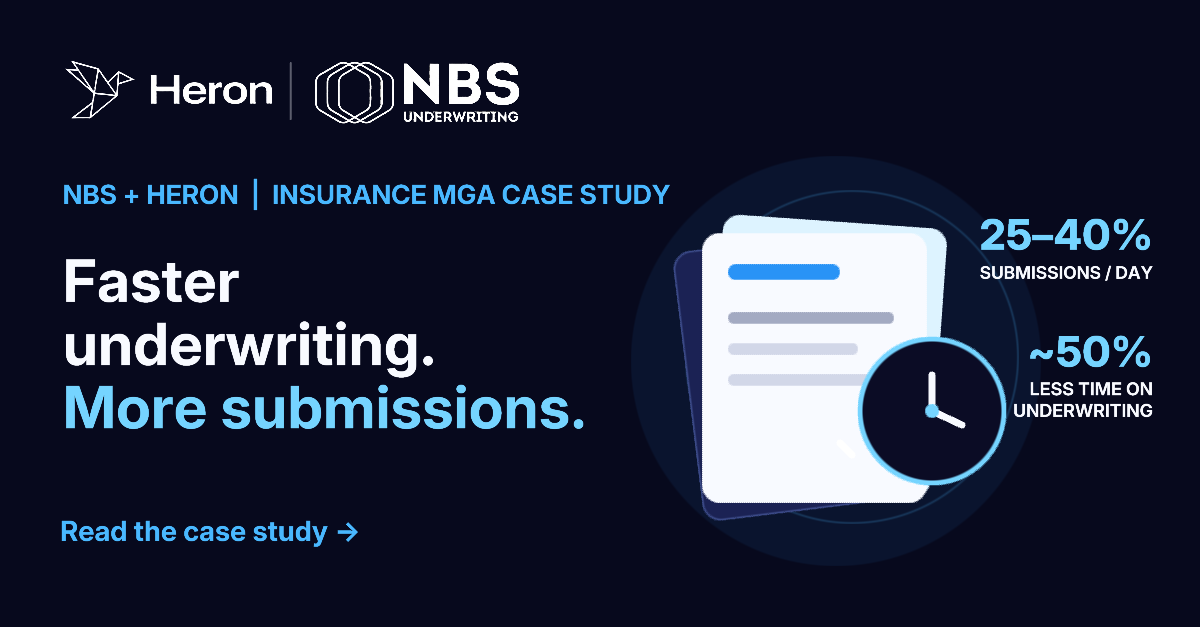
Heron flags out-of-appetite cases from the outset, so an underwriter never keys a full case just to decline it. With that and the manual re-keying gone, underwriters spend their time on the risk, not the admin around it, cutting underwriting time on each case by roughly 50%.
“Heron’s telling them from the outset that a case is to be declined. They’re not having to waste any time figuring out that it’s a decline — they know right from the outset.”
The payoff is throughput: underwriters now clear 25–40% more cases a day, and, freed from the repetitive data entry, they like the work more for it.
2. More Quotes Without More People
Because NBS can now accept manual submissions, more business finds its way to NBS. For one line of business, in the first three to four months, quote volume rose about 10% — and that number understates the impact, because a soft UK market had comparable lines running roughly 16% down over the same period. Turnaround tightened too: professional indemnity moved from about four days to two, and commercial combined from a day to half a day.
“In the first three to four months we saw a 10% increase in volume — and we’re going through a really soft market, so quote volumes were around 16% down elsewhere.”
None of it required adding headcount — the same team simply handles more. In a soft market where most books were contracting, NBS took share instead of losing it — pure growth on a fixed cost base.
3. The Leading MGA for Broker Service
Brokers increasingly place their business through software houses like Acturis, where a single entry can fan out to multiple carriers at once. But many MGAs aren’t on those platforms, which leaves the broker a choice: re-key the whole risk into each MGA’s portal, or skip the ones that aren’t worth the effort.
By accepting manual submissions through Heron, NBS takes that friction away — a broker can send the submission they already have, in the format they already have it, rather than starting over.
“The perception from our brokers and the market has been really positive. We got a lot of feedback that NBS were leading the way in this space.”
Faster quoting and easier submissions have translated into better service — and into brokers bringing NBS more business, and coming back more often.
Growing the Book Without Growing the Team
Heron turned NBS’s one-way, key-everything portal into a front door that accepts submissions in any format and returns them clean in minutes. Underwriters spend more time underwriting, brokers get answers faster, and NBS grows the book without growing the team.
“We’ve seen underwriters doing between 25 and 40% more cases a day, because they’ve cut their underwriting time by about 50% on each case.”
Heron is now central to how NBS plans to grow. It intends to roll Heron across all 40 of its products — no new product will go live without Heron built in — and it’s developing a broker-facing chatbot widget that drops a submission straight to Heron and returns it ready to complete.
NBS projects that once every line runs through Heron, quote volume could climb 25% — an estimated £8–10 million of additional premium in the first twelve months. At roughly 500 quotes a day, a 25% lift is a step-change in volume — and with Heron now embedded across the book, NBS has the infrastructure to deliver it.