![5 Insurance Broker Software Solutions You Should Try Out [Different Use Cases]: 1. Heron 2. Zoho 3. Insureio 4. Riskonnect 5. Insurity](https://cdn.prod.website-files.com/6759b60b29bf1f17d2f1e5ec/6931929b84a1f6c3d853891f_insurance%20broker%20software.png)
Ever feel like your whole day disappears into admin work before you even get a chance to review real risks? Most insurance brokers know that feeling too well.
You get flooded with submissions from retail agents, each one in a different format, sitting in crowded inboxes. You try to check every file against carrier appetites, but slow sorting and missing details make the process drag.
By the time you pull the right documents, rate the risk, and get ready to negotiate terms, the clock is already against you.
That’s why the right software matters. The right platform can cut out repeat tasks, keep your data in one place, and help your team move faster without adding more people.
In this article, we’ll walk through 5 insurance broker software worth trying. Each one helps solve common bottlenecks and gives you a clearer, smoother way to manage your book of business.
What Is Insurance Broker Software?
Insurance broker software is a specialized tool that helps you run your daily work with ease. These platforms bring your customer data into one place so you can find what you need without digging through different systems.
They give insurance professionals a simple way to manage quotes, policies, claims, billing, and automate repetitive insurance tasks that can slow them down.
These systems use advanced technology to support every part of your workflow. You get innovative solutions that help you stay organized, keep your files secure, and protect your agency from mistakes that come from manual work.
When all tasks live in one line of tools, you also gain insights about your company and the people you serve.
Many brokers use these specialized solutions to build stronger relationships with clients. Clear records make it easier to follow each step and offer real value during every conversation.
5 Insurance Broker Software For Teams Needing Faster Workflows
Investing in insurance broker software helps you manage your work more effectively and empower your team as you scale. It also helps you execute tasks with less stress and more clarity. Here are our top 5 picks you should check out today!
1. Heron for Submissions Intake
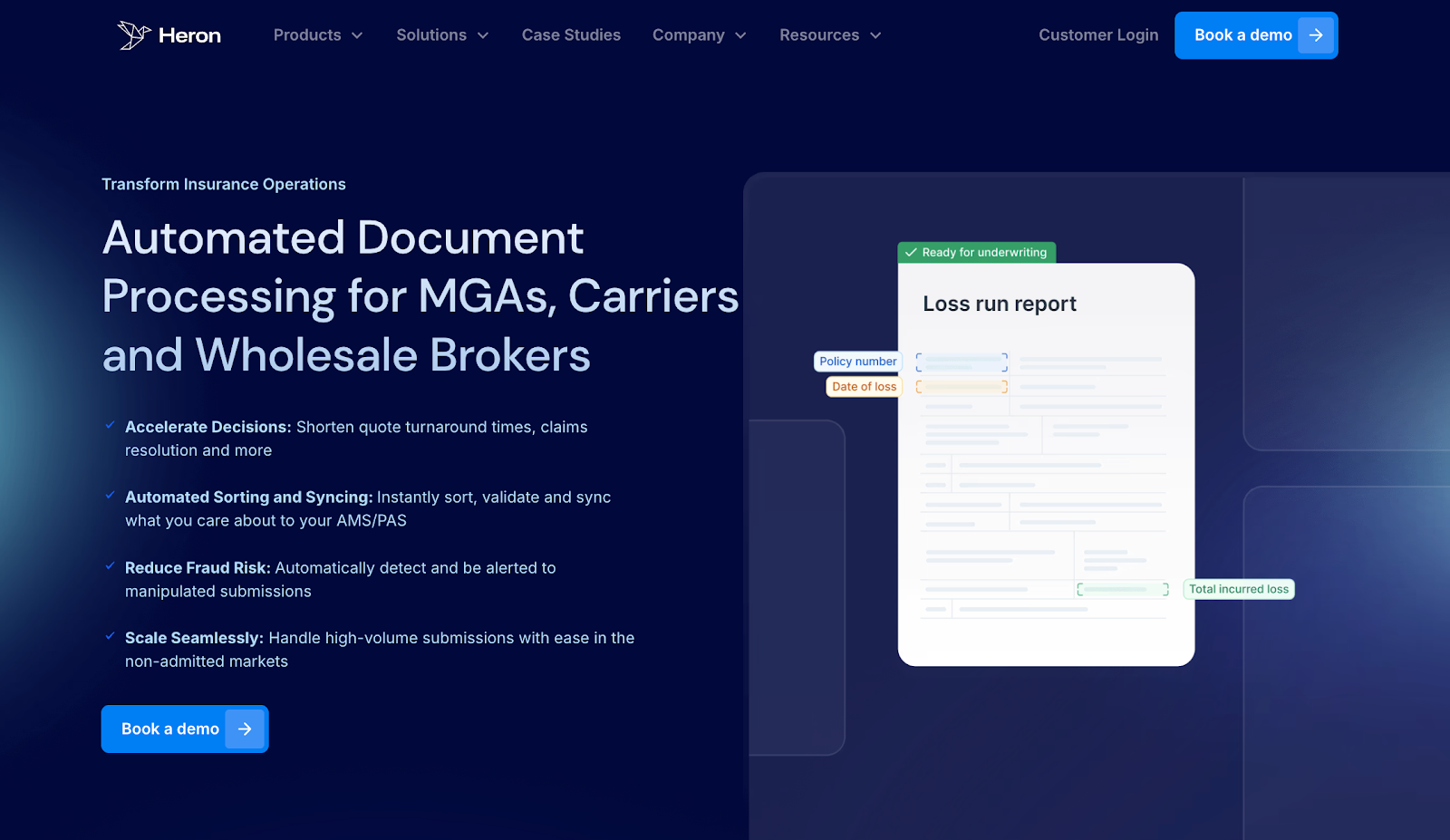
Heron helps high-volume MGAs, carriers, and wholesale brokers move fast by removing the slow manual work that blocks underwriting.
It pulls documents from shared inboxes, reads them with 99.5% accuracy, and turns them into clean data your systems can use.
Heron supports more than 50 document types, including ACORD forms, loss run reports, supplemental applications, SOVs, and processes over 100,000 files every day. Even low-quality scans and handwriting are handled with insurer-grade accuracy.
With Heron, submissions move from inbox to system in seconds, which helps underwriting review risks sooner and turn quotes around faster.
Key Features
- Automated submission intake - Pulls ACORDs, loss runs, SOVs, and other insurance files from shared inboxes so teams avoid manual downloads and sorting
- Document classification for insurance workflows - Identifies and groups key insurance documents such as supplemental applications, inspection reports, and driver lists, so underwriters get organized files immediately
- Low-quality scan handling - Processes handwritten notes, scanned PDFs, and mixed-quality submissions so insurers do not lose time requesting cleaner files
- Fraud and tampering checks - Flags potential manipulation in ACORDs, loss runs, or SOVs so insurers catch risk early
- Coverage and policy rule validation - Reviews submissions against your coverage rules and intake criteria so underwriters only see complete, decision-ready files
- Data enrichment for underwriting - Adds extra details such as business industry, NAICS codes, and other third-party fields so insurers have more context before quoting
- Direct syncing to AMS and PAS systems - Sends structured underwriting data into systems like Guidewire, Duck Creek, Veruna, Novidea, Zoho, and Salesforce without any rekeying
2. Zoho for Insurance CRM
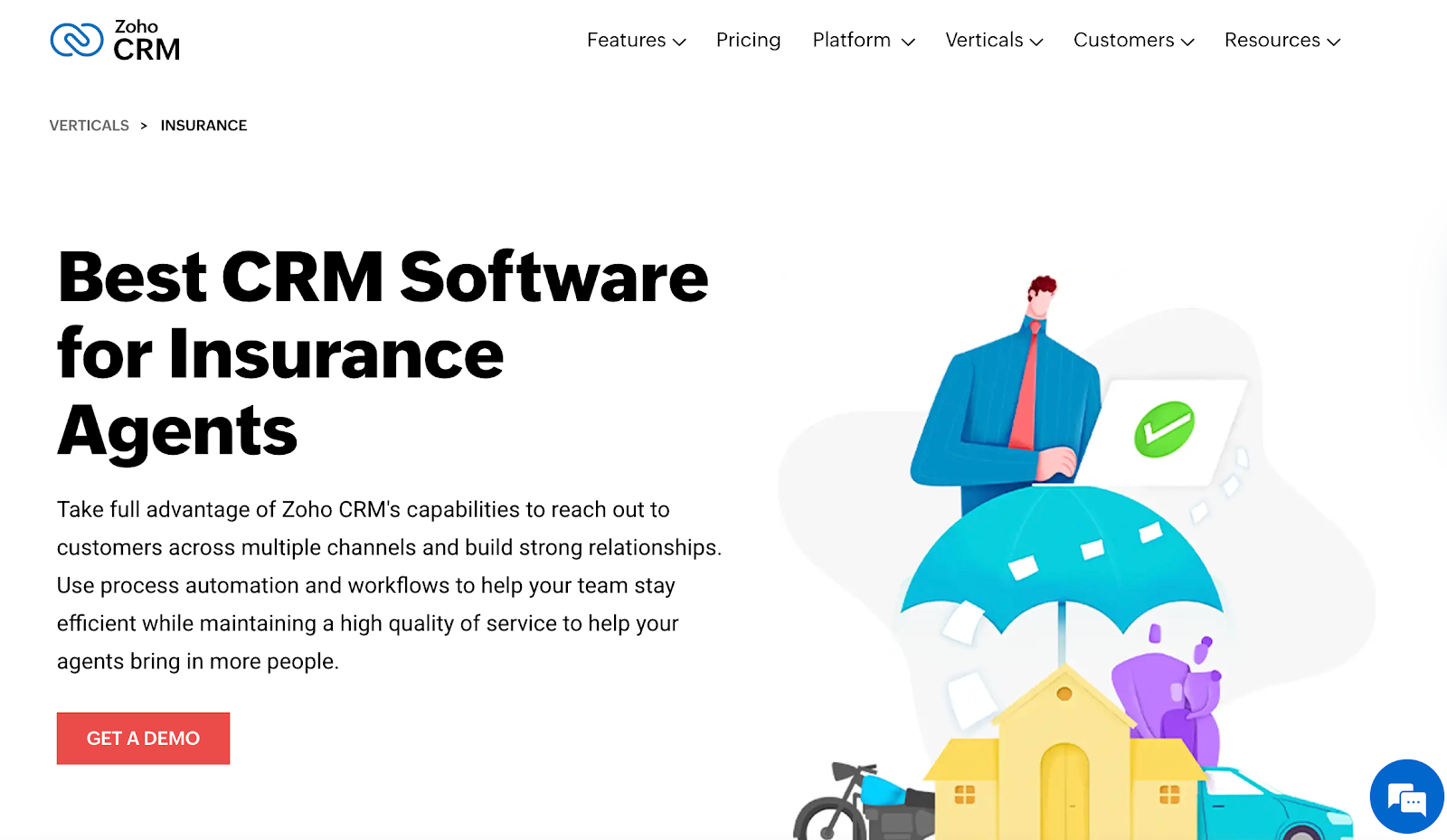
Zoho for Insurance CRM helps insurance agents and brokers manage leads, policies, and claims in one system. It streamlines workflows, organizes customer information, keeps track of interactions across channels, and supports teams with tools that guide daily work.
Agents can use it to follow up with prospects, manage renewals, and maintain clear records for each policyholder.
The system also helps teams standardize processes, assign tasks to the right people, and keep customers informed at the right time. With web, mobile, and integration options, teams can access their data anywhere and connect the CRM with other tools in their workflow.
Key Features
- Lead and policy management - Organizes customer details, leads, and multiple insurance policies in one system
- Omnichannel communication - Combines email, phone, chat, and social channels into a unified view
- Workflow and reminder automation - Sends renewal alerts and follow-up tasks to help agents stay on schedule
- Claims routing - Assigns claim requests to the right team members for faster handling
- Analytics and reporting - Shows forecasts and key metrics to help teams understand performance
3. Insureio for Marketing & Lead Management
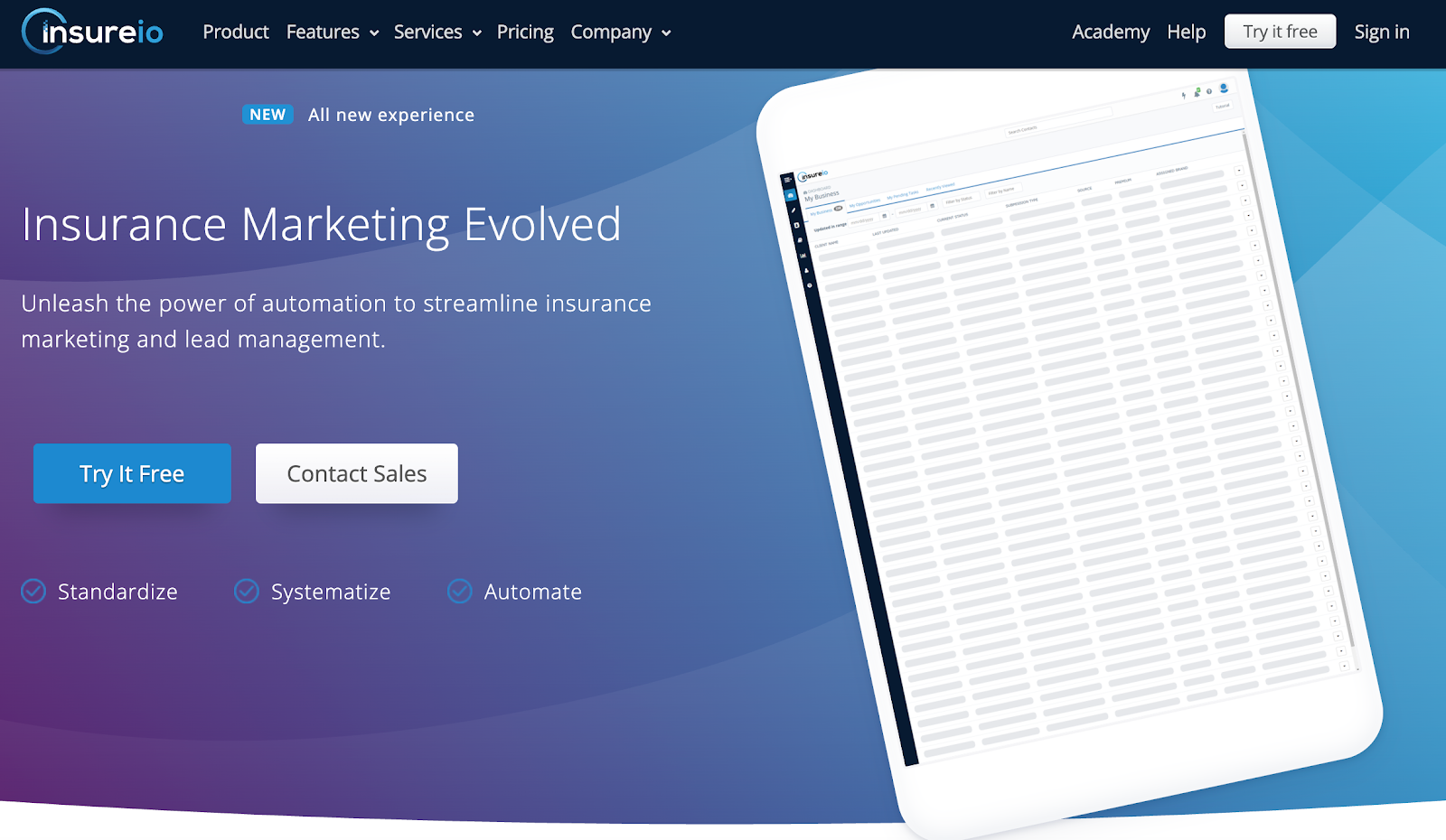
Insureio is a marketing and lead management platform built for insurance agents who want a more organized way to track prospects and handle daily tasks.
It brings lead tracking, communication, marketing tools, and application support into one system so agents and organizations can move through their sales process without juggling multiple platforms.
The system helps teams follow leads through each stage of the funnel, automate basic workflows, and manage client communication in a consistent way.
Key Features
- Lead tracking tools - Organize leads, tasks, events, and policies in one place for easier follow-up
- Case and application management - Supports application routing, status updates, and e-policy delivery to reduce manual effort
- Marketing automation - Sends nurture emails and follow-ups through pre-built campaigns and templates
- Quoting support - Provides access to quotes from many carriers through a simple form that collects needed client details
- Custom campaign builder - Lets agents create and manage personalized marketing campaigns without extra tools
4. Riskonnect for Risk Assessment

Riskonnect helps insurance brokers bring risk data, workflows, and analysis into one system. It organizes information from different sources, gives teams a clear view of exposures, and supports risk reviews across clients and lines of business.
Brokers can use it to track claims, monitor compliance tasks, and review key risk indicators without switching between tools.
The system also supports routine processes by automating steps that are often handled manually.
Key Features
- Centralized risk data - Brings claims, exposures, and key records into a single system for easier review
- Automated workflows - Reduce manual work by automating steps in claims handling, compliance checks, and routine tasks
- Risk analysis tools - Helps teams identify patterns, evaluate exposures, and prepare insights for client meetings
- Real-time reporting - Provides dashboards and reports that offer an updated view of risk across accounts
- Client account support - Helps brokers manage renewals, track activity, and deliver organized information to clients
5. Insurity for Policy, Billing & Claims Management
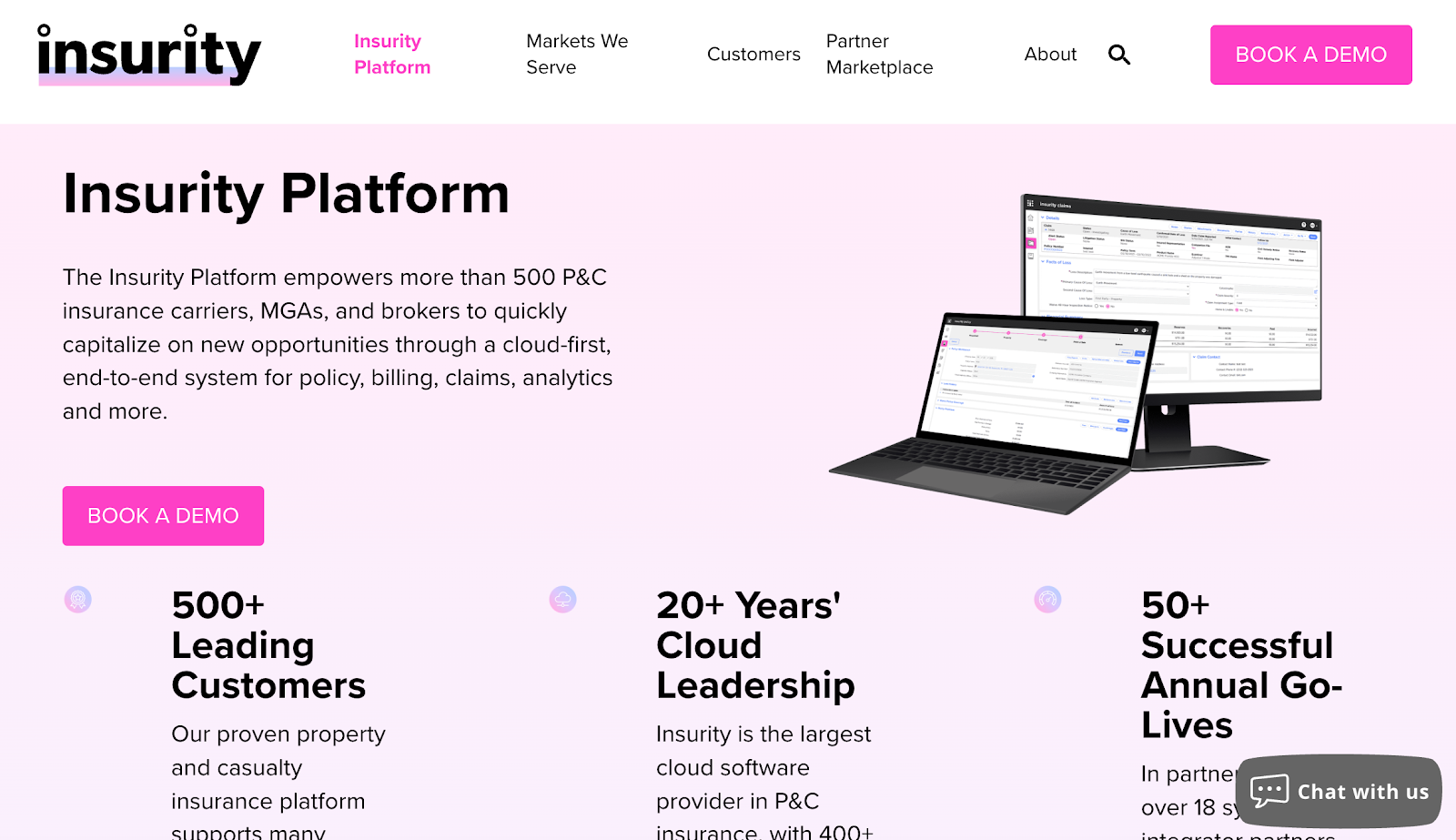
Insurity gives insurers a single platform to manage policy administration, billing, claims, underwriting, and analytics in one place.
It helps carriers, MGAs, and brokers handle daily work with a cloud-first approach that supports commercial, personal, and specialty lines.
The system brings policy, billing, and claims workflows together so teams can process work faster, reduce manual steps, and keep data consistent across the full policy lifecycle.
It also supports multiple distribution channels and offers tools for underwriting, reporting, and payment handling.
Key Features
- Policy administration – Manage policy creation, updates, and renewals with tools built for commercial, personal, and specialty lines
- Billing management – Support various billing plans and payment methods through a flexible billing system that handles the full billing lifecycle
- Claims handling – Process complex or high-volume claims in one place using workflows that help teams resolve cases faster
- Claims payments – Manage payments from approval to issuance in a single workflow to simplify payout steps and improve consistency
- Underwriting workflows – Use a rules engine and data integrations to support underwriting checks, guide decisions, and reduce manual review
Benefits of Insurance Broker Software
Many brokers in the insurance industry feel pulled in different directions. You deal with long processes, busy operations, and pressure from the market.
It can be hard to give customers the attention they expect while also keeping up with underwriting work and policy changes.
Insurance broker software helps you handle these tasks with less stress and gives you more time to focus on new business and stronger service. Let’s discuss how it can transform your processes in more detail:
Smoother Operations That Save You Time
When your team works on one platform with smart automation, underwriters get more time back in their day.
These tools cut back on long wait times and reduce the need for repeated steps. You also spend fewer resources on manual checks because the insurance automation platform handles most of the routine work for you.
This helps you support policyholders and customers with more care since your time goes toward real conversations instead of slow admin work.
Support For More Informed Decisions
Sophisticated analytics features give you a clear look at how your market behaves across your niche.
You can study loss trends, review your approach to risk, and see which channels perform well. This makes it easier to shape strategies that match the needs of your specialty lines.
Underwriters make informed decisions based on real data and not on rough guesses. Over time, this helps your company move with more confidence in every cycle.
Faster Growth For New Business
MGAs grow when they respond fast and present solutions that meet very specific needs. Simple processes help you do this. With cleaner workflows, insurers can serve clients before competitors reach them. This focus on innovation also helps you stay quick and flexible.
The platform helps you match each product to the right people because it highlights patterns in your customers and your policyholders.
This creates a stronger connection with every partner you work with and supports steady profitability. Each aspect of the process stays clear, which helps keep your operations stable.
Improving Accuracy Across Your Work
Accuracy matters when you handle unique risks. Automation removes extra steps that often create errors, especially in complex lines like cyber or fleet. Your files update in real time, and your processes stay clean.
Insurance technology protects your company from unnecessary exposure and gives customers a smooth experience from start to finish. It also builds trust with carriers who rely on you to underwrite with care.
Turn Your Inbox Chaos Into Clean, Ready Data with Heron
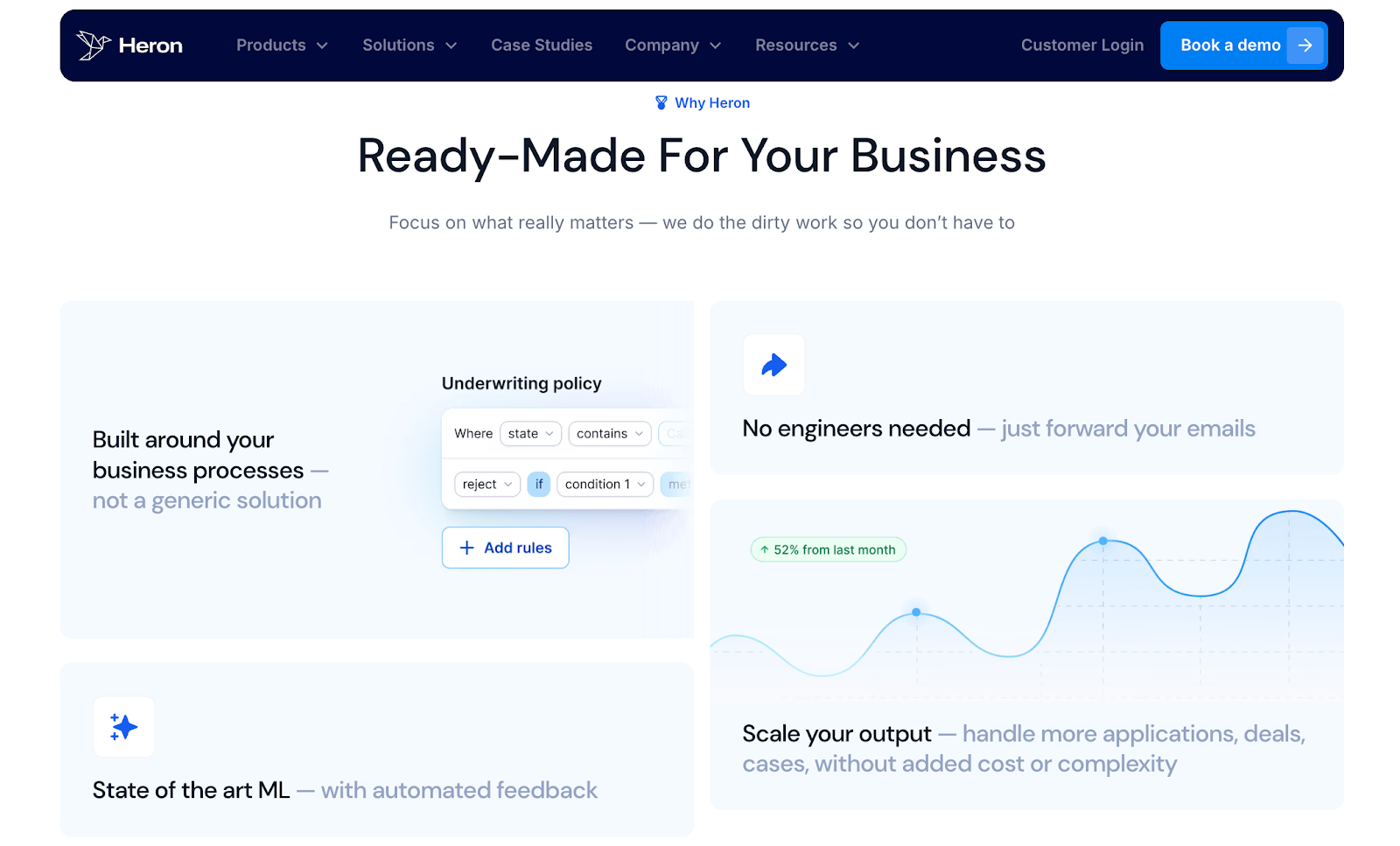
If you want to scale without adding more employees, Heron gives you the power to do it. You cut hours of admin work and turn your messy inbox into clean data you can use right away.
Many MGAs move from slow reviews to fast decisions because Heron reads more than 50 document types with strong accuracy, even when files are scanned or handwritten.
This improves your underwriting efficiency, allowing you to respond within hours, not days, which drives growth and long-term success.
Heron gives you seamless integration with your current system, so you avoid long rebuilds. Your agents send submissions the same way they do now, and the platform handles the rest.
It pulls data into your PAS or CRM, checks each file, and prepares everything for your broker and underwriting teams. You save real money because the work that once cost more than $50 per application now takes seconds.
Heron helps you stay in line with regulations, use predictive insights in your process, and scale more easily for your future endeavors.
FAQs About Insurance Broker Software
What systems do brokers use?
Brokers use insurance management systems that help them handle clients, track policies, and manage daily work in one place. These tools connect with many insurance carriers, so brokers can compare rates, bind policies, and sync data without extra steps.
What software is used in insurance?
Insurance teams use software that supports underwriting, policy admin, claims work, and customer management. Popular platforms include Heron, Acturis, Foliume, Vertafore, Guidewire, and Sapiens, which offer cloud tools, simple workflows, and real-time updates.
What is broker software?
Broker software is digital tech that helps insurance brokers manage clients, quotes, and policies with less manual effort. It brings key tasks like client data, carrier connections, automated quoting, policy binding, and document handling into one system.
How does open API architecture help insurance broker software connect with other tools?
Open API design lets different tools talk to each other without extra steps. It makes data flow smoother across platforms, helps with simple analysis, and keeps the broker’s workflow easy to manage.