Ever wonder how many fraudulent documents slip through without anyone noticing? Underwriters deal with long queues, messy files, and pressure to move fast.
You chase missing pages, compare numbers that do not line up, and try to catch problems before they hit your book. It gets harder when fraud grows more complex and the tools you use cannot keep up.
This guide walks you through what document fraud is, the usual documents businesses may fake, and how document fraud detection software helps you stay ahead.
What Is Document Fraud?
Document fraud happens when someone tries to trick you or your team by using papers that are not real or have been changed. Some people create falsified documents from the ground up.
Others take genuine documents and change small details like names or dates. These fraud attempts can be hard to spot if you look at the surface only.
You may see this with financial documents such as bank statements, tax forms, IDs, or certificates. A business might try to use fraudulent documents to get funding approved or to hide cash flow issues, unpaid debts, or false claims about ownership.
When this happens, you face the risk of fraudulent transactions that can harm your review process and lead to bad funding decisions.
What Are the Types of Document Fraud?
You might wonder how many ways someone can fake a document. The truth is that fraudsters use many tricks, and you see more fraud as advanced technology becomes easier to access.
Here are the main types you should know:
- Basic forgery - Someone edits real papers to change names, dates, values, or even a job title. These edits turn them into fraudulent documents that look normal at first.
- Document alteration - A person changes parts of genuine papers to hide facts or gain access they should not have.
- Document image fraud - Images, stamps, or signatures inside a file are edited to change how the record looks.
- Pseudo document fraud - A fake diploma, contract, or letter is created from scratch.
- Invoice fraud - Someone creates or edits an invoice to pull money out of a process. This can include fake bank statements added to support the claim.
- Synthetic identities - Real and fake details are mixed to create new profiles. It is a form of synthetic fraud that can link to many record types.
- First-party fraud - A person uses their own identity but edits records to look stronger, such as changing income.
- Third-party fraud - Someone uses stolen or made-up details to act as another person.
Financial Documents People Try To Fake
Underwriters deal with many incoming documents every day. It helps when you know which files people fake most often. Here are some files you will see often and should watch closely:
Altered Financial Statements
Some businesses may edit their income reports or balance sheets to look stronger on paper. They might raise revenue, remove debt, or edit past activity to impress a funder.
If these pass your document processing steps, the result can be fraud losses and weak compliance.
Always slow down when numbers look too smooth or when the layout looks even slightly different from real records.
Fake or Tampered Bank Statements
Bank statement fraud happens when someone edits their statements to look stronger than they really are. A tampered bank statement may have mixed spacing, small shifts in alignment, or fonts that do not match the rest of the file.
Columns might sit a little off, and the metadata may mention tools like “Quartz PDFContext” or “iLovePDF,” which can point to direct edits. Added boxes, highlights, or patched areas also suggest someone changed the file by hand.
Some figures may also look too smooth, the activity may not fit normal spending habits, or the balances may jump in ways that do not make sense.
These edits are notoriously hard to spot during quick reviews. And if you miss them, your team may approve deals that should not move forward, take on higher risk without knowing it, or spend weeks dealing with losses that could have been avoided.
Reviewing each statement one by one and checking for signs can be time-consuming.
Fortunately, you can use a reliable bank statement verification software like Heron to make sure the business bank statements you're reviewing are genuine without slowing down your work.
Falsified Contracts
A business may send a contract that claims deals or partnerships that never took place. They might change payment terms, switch out pages, insert new signatures, or make an entire fake contract using AI.
These contracts help them look more stable, more experienced, or more prepared than they truly are.
If treated as accurate, your business may approve requests based on relationships or obligations that do not exist.
Fake IDs
Some businesses submit fake IDs when they want to mask who actually controls the company. This often happens when a business tries to hide past financial issues, adverse media, or pending court cases.
A fake ID might list a different decision maker or replace a real owner with someone who appears easier to approve. These files usually look close to the real thing, which makes quick reviews risky.
If these forged identity documents pass your checks, you may approve funding or coverage for a company whose true leadership structure does not match the file.
Fake Addresses
Businesses may use fake addresses to look more stable than they truly are. Some list a new address to appear larger, more established, or more creditworthy.
Others use a borrowed address to hide a high-risk location or avoid showing that they operate from a temporary space. You may see fake addresses in applications, contracts, or invoices.
If these records pass your review, you could trust a business that has no real presence in the location it claims, which also affects risk scoring, compliance checks, and due diligence steps.
Fabricated Tax Returns
These returns often show inflated income or false payment history. A business may edit past tax data or build a full file from scratch.
These tricks also support synthetic identities and identity theft. If you miss these signs, you may trust a financial picture that never existed, which can lead to major fraud losses.
Blank Official Documents
Blank checks or blank order forms get stolen and then filled in with new details. With AI-generated documents, a business can take that blank form and create a fresh version that looks clean, sharp, and complete.
AI tools can rebuild the layout, smooth out scanned edges, add new text, or blend in a signature so it looks like a normal record.
These files can show payment activity or past purchases that never took place. They pass quick reviews because the base form is real, and the AI edits hide the changes.
What Is Fraud Detection?
Fraud detection is the process you use to spot signs that something is not right in your files or transactions. It helps you detect fraud before it grows into a larger problem.
You look for odd patterns, strange numbers, or records that do not match the story a business gives you. Strong fraud detection solutions also help you detect fraudulent documents and check document authenticity with more confidence.
You may use identity verification tools, systems that verify income, or steps that confirm that a record came from a real source.
Many teams also use artificial intelligence, machine learning, and deep learning to scan large amounts of data. These tools learn what normal activity looks like, then alert you when something falls outside that pattern.
Good fraud detection supports your fraud prevention efforts and keeps your reviews clean. It gives you more clarity when you handle risk, and it helps you trust the files you work with each day.
Common Fraud Detection Methods
When you look for fraud, you have a few common methods that help you spot problems early. Each one gives you a different way to stop fraud before it affects you negatively.
- Rules-based detection - You set fixed rules or limits that flag activity that does not match normal behavior. These rules help you spot strange amounts, odd timing, or patterns that break your usual standards.
- Data analytics and pattern recognition - You scan large sets of data to find numbers or trends that stand out. These signs point you to issues that do not follow past records and need a closer look.
- Machine learning and AI - You use models that study past data and real-time activity. These models learn what normal looks like and alert you when behavior shifts in a way that rules alone cannot catch.
- Forensic audits - You take apart financial records step by step. You trace every part of a transaction to confirm that the source, flow, and outcome match the story you were given.
How Heron Flags Fraud In Your Documents
Heron gives your team a clear and fast way to spot fake bank statements and other documents before they reach underwriting.
The platform reads each file in seconds and checks both the content inside the document and the layout it was created with. This helps you catch small edits that are easy to miss during manual reviews.
Heron uses a dual-analysis method that combines two powerful checks to find signs of fraud fast. These are:
Intra-Document Analysis
Heron checks every column, date format, font, and spacing pattern to see if anything breaks the structure real banks use.
It reviews the PDF’s producer data to see how the file was created and flags tools known for editing, like iLovePDF.
It also scans the hidden metadata and embedded data inside the file to catch small changes that would never show up in a quick manual review.
Inter-Document Comparison
Heron compares the file to its own large set of real, authentic statements. Every bank has its own layout “fingerprint,” and Heron knows the spacing, margins, font rules, and structure for each one.
It checks whether the file matches these patterns down to the millimetre.
Heron also knows when a bank makes real updates to its layout, so legitimate changes do not raise false alarms.
Heron Score
Heron also gives each bank statement a score that shows how closely the file matches real banking formats. Here's what the platform looks for when deciding the score:
- PDF producer data - Checks the software used to create the file, since non-standard tools often raise flags.
- Column position accuracy - Reviews how each column lines up, because real banks use fixed layouts with very little variation.
- Text alignment and formatting - Looks at how clean and consistent the layout is, which helps reveal moved or edited sections.
- Font variations - Spots mixed or irregular fonts inside the file, which often signal copied or altered text.
- Metadata analysis - Reads the hidden data inside the PDF to find anything in the file structure that seems out of place.
Why Is Document Fraud Detection Important?
When you review files from a company, you want to trust what you see. Let's look at how strong fraud detection can help your business prevent fraud:
Helps You Avoid Financial Losses
Fake records can lead to costly mistakes. A loan supported by edited numbers or fake claims is far more likely to fail. Missed red flags create direct financial losses that fall on your team. This is even harder when manual reviews miss key details.
For example, if a business hides a pending case with a false ID or edited document content, the average loss can reach $85,000 for each missed judgment. This makes strong document verification a key part of your daily work.
Supports Better Risk Decisions
When you know a file is real, you can score the request with more confidence. You can read the story behind the business, judge the size of the risk, and decide if the request fits your standards.
If a company submits altered data, you may think the business is stronger than it really is. That leads to choices that place your organization at risk of more fraudulent activities later.
Supports Compliance
Many funders and insurance groups must follow know your business (KYB) and anti-money laundering (AML) rules. Good checks help you verify documents and confirm that the business meets the rules you follow.
If you miss a fake file, you may face legal costs or penalties. Strong document verification keeps you aligned with the standards expected in your field.
Improves Your Daily Workflow
Manual reviews can be time-consuming, and they often need heavy human intervention. Modern tools use machine logic to scan files, read document content, and highlight what needs your attention.
This helps you move faster while keeping the quality high. You save time on long checks and spend more time on decisions that matter.
Start Catching Fraud Before It Reaches Underwriting with Heron
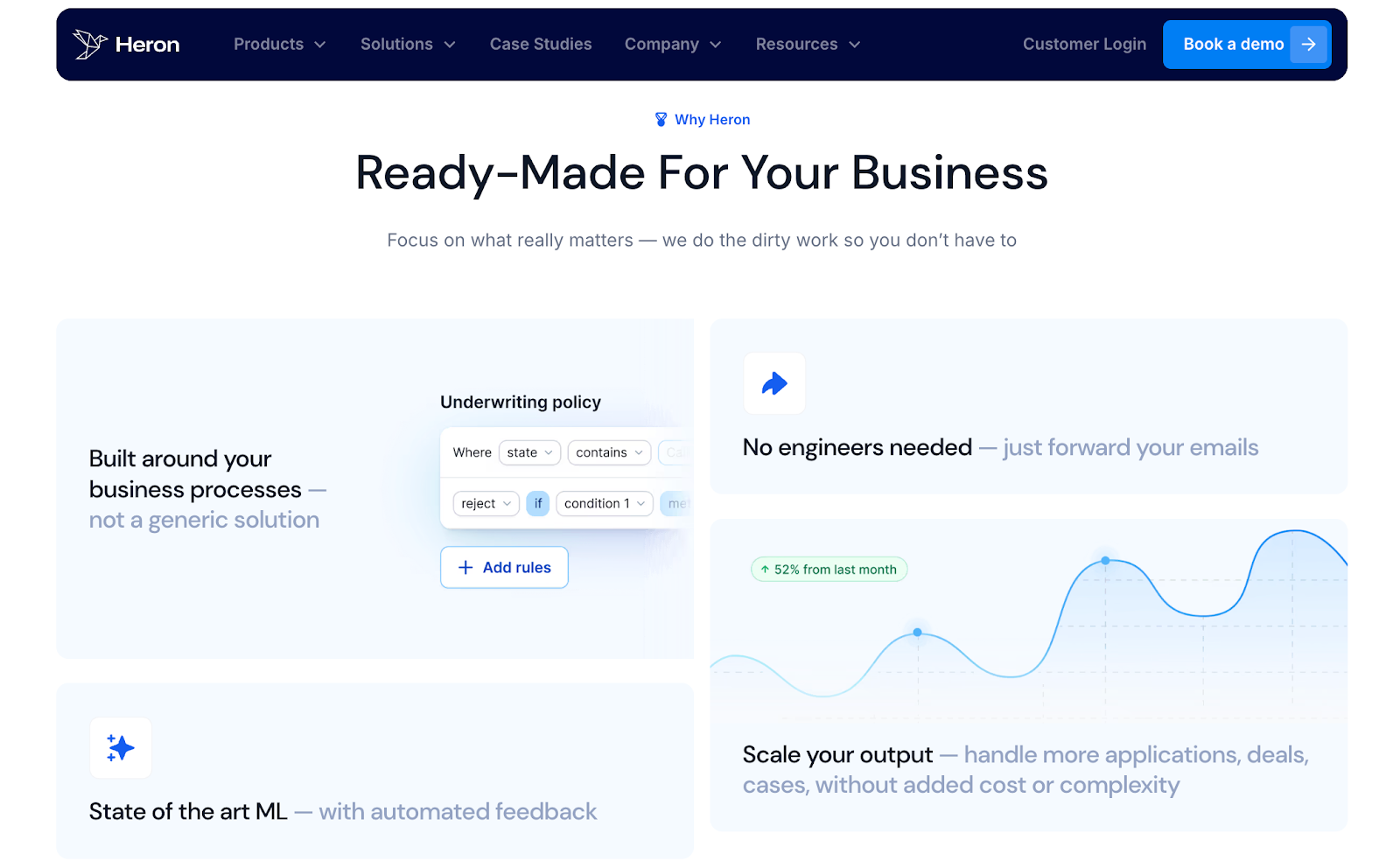
Heron is a document automation platform built for high-volume funders and brokers. The platform gives you a simple way to fight fraud, speed up your reviews, and protect your book without adding headcount.
You get clean data, fast checks, and clear answers that help you move with confidence. Every part of the platform is built for high-volume funders and MGAs that need real structure, real accuracy, and real speed.
Faster Processing With AI-Powered Tools
Heron cuts your processing times from minutes to seconds. You can parse any document type, pull clean data with 99.5% accuracy, and remove hours of manual work from your day.
You also get results based on trusted data sources, so you never have to guess if the file is real. This helps you lower your risk while keeping your team focused on funding, not sorting paperwork.
Spot Fake Businesses Easily
Heron helps you verify businesses easily through its rich KYB tools.
SOS Checks return real-time status from all 50 states plus D.C., catching dissolved or fake entities before you move forward.
Court Search unifies federal and state records and pulls results in under 5 seconds, including lawsuits tied to the business and the owners. This helps you see pending court cases, active judgments, and name variations that manual searches often miss.
Heron's Web Presence analysis checks the entire online footprint of a business and its owners in seconds. You see website activity, social profiles, reviews, and signals that help you confirm the company is real and operating.
You no longer need to guess if a business is active, stable, or even real. You can see the truth in seconds.
Smart Flagging And Detection
When a submission breaks your rules or misses key details, Checks sends instant alerts that show exactly what went wrong.
You see clear notes like “Incomplete Data Detected” and get the context you need to decide if the issue requires a closer look or if it is a false alarm.
This helps your team act fast and stay focused without digging through every file by hand.
Detect Fraud in Bank Statements Easily
Heron reviews bank statements in under a minute and checks for signs of tampering as it parses the file. You can send PDF statements or data from API aggregators, and the system processes about 90% of them with more than 99% accuracy. If a statement cannot be parsed, Heron tells you right away.
As the data is extracted, Heron looks for missing days, mismatched balances, odd patterns, and formatting clues that signal edits or altered numbers.
It can also compare multiple data sources for the same business to catch conflicting revenue or balance history.
After parsing, Heron enriches the data and highlights key signals like true revenue, NSF days, balance trends, and other risk factors.
FAQs About Fraud Document Detection
How to detect document fraud?
You can spot document fraud by checking for signs that something looks off, like mismatched fonts, blurry text, odd spacing, or details that don’t line up with known records. A quick check with an ID check tool or a trusted database also helps confirm if the document is real or not.
What software detects fake documents?
Tools like a document verification platform, such as Heron, can scan files, read key data, and flag signs of tampering. Many of them use artificial intelligence to compare the document against trusted sources, which makes it easier to see if anything has been changed.
What is considered document fraud?
Document fraud happens when someone alters, creates, or uses a fake record to hide the truth or gain something they shouldn’t. This can include edited IDs, false financial papers, or any paperwork that has been changed to mislead others.
What is the No. 1 way to detect fraud?
The most common way to detect fraud is to verify information with a trusted source. When the details on a document don’t match official records, it becomes clear that something is wrong. This simple check stops many fake documents from going through.