
What happens when a business needs funding but has no assets to place as collateral? Many firms turn to unsecured loans, a form of borrowing money that does not rely on collateral.
With unsecured loans, you make your decision based on the borrower's creditworthiness, income strength, and overall financial health. You also need to look at each file with more care because one bad approval can lead to a large loss.
In this article, we'll discuss what the approval process for unsecured loans is, understand the difference between secured and unsecured loans, why businesses apply for them, and more.
Unsecured Loans: Process and Examples
The loan process for an unsecured loan is simple: you need to check if the borrower can handle steady loan payments by examining key aspects of their financial health.
You can review their cash flow, debt-to-income ratio, bank statements, and other financial records. These details will help you see whether the applicant can maintain steady loan payments over time.
Once you're satisfied, you can then finalize the loan. This includes setting repayment terms such as the length of the agreement and the expected monthly payments.
If a borrower defaults on an unsecured debt, you cannot take property or other possessions to cover the balance. Recovery usually depends on collection efforts or legal action.
For example, if an applicant misses loan payments for their unsecured personal loans, the case may be sent to a collection agency, or you may pursue a legal claim to recover the amount owed.
Now that you know how the process works, let's look at the common types of unsecured loans in general lending:
- Personal loans
- Federal student loans
- Private student loans
- Signature loans
- Credit card debt with a set credit limit
- Revolving credit offered by banks and online lenders
Secured vs Unsecured Loans: What's the Difference?
Secured and unsecured loans differ based on whether they require collateral.
Secured loans are backed by collateral. Property or other assets help reduce risk, so these products can work for applicants with lower credit scores. Common examples of secured loans are mortgage loans, home equity loans, and auto loans.
If missed payments occur, you can take the asset to recover the balance. Because they're secured, these loans often have longer terms and more flexible structures.
Unsecured loans, as we mentioned above, do not rely on assets. Approval depends on income strength, high credit scores, past repayment behavior, and the overall financial stability of the applicant.
Unsecured loans often carry higher interest rates compared to secured loans because there is no asset to fall back on. Longer terms can sometimes support lower monthly payments, but loan amounts are usually smaller.
Unsecured Loans in SMB Finance
Unsecured loans in SMB finance give small to medium-sized businesses a way to access funds without tying the loan to business assets.
These loans rely on unsecured credit, so you need to look closely at the company’s financial stability, cash flow, credit history, past payment behavior, and other records.
Based on these financial factors, you need to set the loan agreement based on the company’s ability to keep up with monthly debt payments. Unsecured loans also move fast because there is no asset check.
Debt repayment for unsecured loans is usually set in fixed amounts. If a firm defaults on the loan, you have no assets to fall back on, and the loss can cost you thousands of dollars. Hence, you have to do proper due diligence to confirm the business is real, active, and trustworthy.
What do you get from offering unsecured loans? They can help you reach more borrowers with no collateral, which grows your customer base. These loans also come with higher interest rates, which helps you balance the risk and boost profit.
Heron helps you handle 2x the loan submissions without hiring new staff. Book your demo today!
Types of Unsecured Loans Businesses Take
Unsecured loans come in several forms and can be offered by various financial institutions such as banks, credit unions, and MCA funders. Below are some common examples:
- Term business loans - Can be short, medium, or long term. Fixed lump sums repaid over set periods. Firms use them for working capital, small upgrades, or light expansion.
- Business lines of credit - Flexible access to funds up to a set limit. Funds can be drawn, repaid, and drawn again as cash flow shifts.
- Merchant cash advances (MCAs) - Funding based on future sales. Repayment comes from a share of daily card sales or revenue, which adjusts with business activity.
- Invoice financing - Short-term funding backed by unpaid invoices. This gives firms cash before customers pay their bills.
- Business credit cards - Revolving credit for small expenses and short-term needs. They help with day-to-day spending and quick purchases.
- Small Business Administration (SBA) loans - Government-backed loans under $50,000 that may be unsecured and provide favorable terms, often requiring personal guarantees.
Why Do Businesses Take Unsecured Loans?
Let's look at some common reasons why businesses apply for unsecured loans.
No Collateral Required
Many businesses choose unsecured loans because there is no risk of losing property or equipment.
A young company may not own valuable assets, while an established firm may want to keep its assets free for future plans like leasing new equipment or securing a long-term contract.
With no asset tied to the deal, owners avoid added pressure and can focus on daily operations instead of gathering documents or arranging asset checks.
Fast Approval Process
Unsecured loans help firms act quickly when cash flow shifts. A business may need help covering unexpected expenses, like a sudden repair, a supplier delay, or a temporary drop in sales.
Since there is no collateral to review, the process moves at a faster pace. This speed can prevent service delays, keep staff working, and avoid missed opportunities during busy periods.
Helps With Consolidating Debt
Some firms use these loans for debt consolidation from several sources. A company carrying outstanding debt across cards, lines, or short-term advances may want one clear structure to manage.
A single payment can make planning easier and help the company stay on track with timely payments, which supports a healthier long-term profile.
Flexible Use of Funds
Unsecured loans give firms freedom to direct the funds where they matter most. Companies with strong credit and solid gross monthly income often take short-term unsecured loans when they need quick support for day-to-day operations.
A business may buy inventory, place a bulk order, or manage a short gap during a slower week. Because the loan is not tied to one purpose, the firm can shift plans as conditions change and use the funds wherever support is needed.
Heron: The Faster Way for Funders to Process Deals
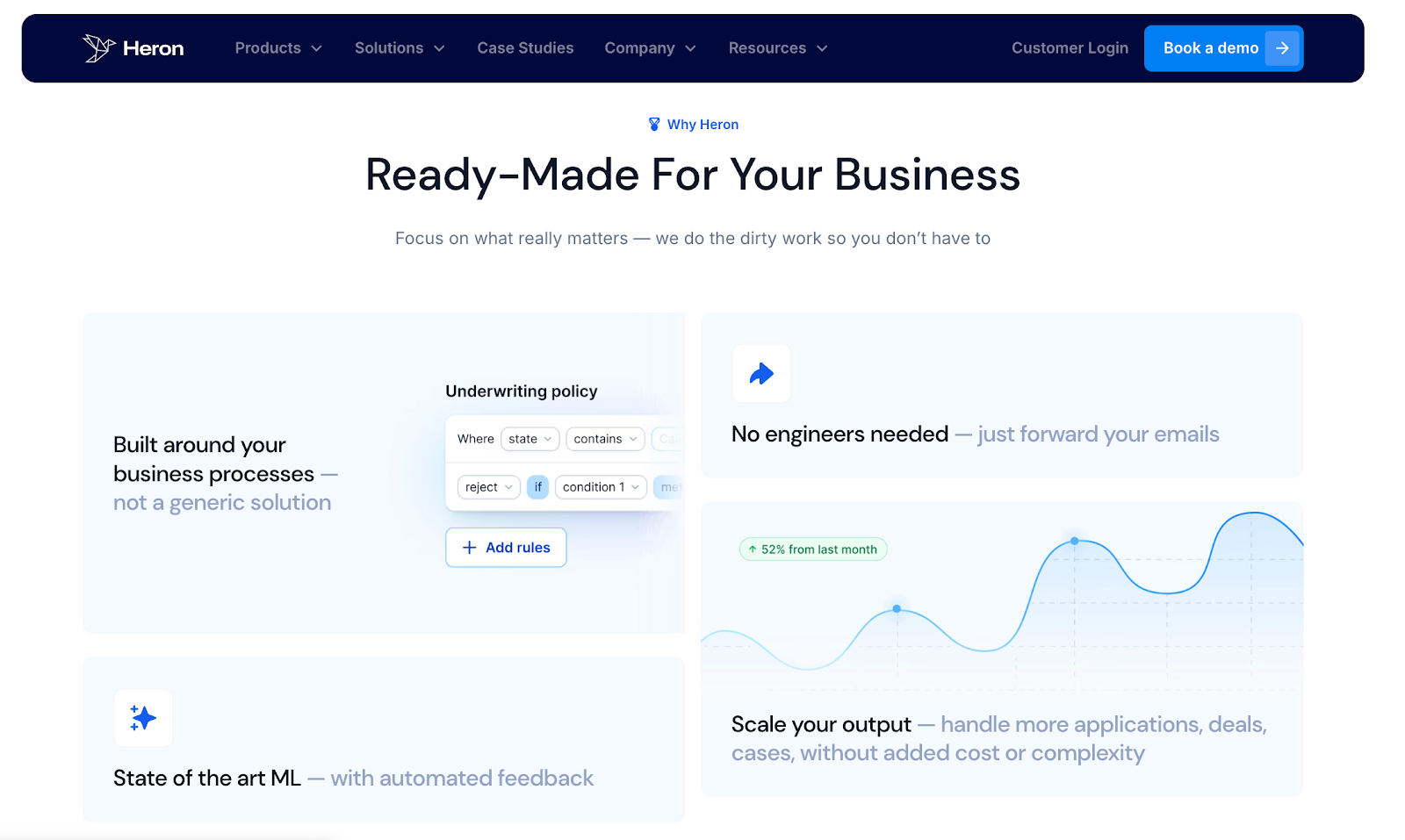
Heron is an AI-powered automation platform that gives you a simple way to move deals from intake to decision without slowing the team down.
It removes manual data work, cleans submission packages from email, reads financial statements, applies pre-set business rules, enriches data, and sends final records to the CRM.
This helps you and your underwriting team handle high-volume applications of unsecured and secured loans, MCA requests, credit lines, and other loan products.
With Heron, you can respond in hours, process more files, and avoid adding new staff.
Speed That Matches Fast Unsecured Deals
Unsecured loans often need quick decisions because there is no collateral review.
Heron supports this speed by pulling data from bank statements, applications, and financial documents in seconds. There is no retyping, no searching through PDFs, and no waiting for processors.
Heron cuts processing costs by more than 75% and helps you handle 2x the volume without increasing headcount.
Data Scrubbing With Real Accuracy
Heron reads banking statements, ISO files, tax returns, and many other document types with 99.5% accuracy.
It removes noise, detects duplicate files, and flags missing fields before the file reaches an underwriter.
The platform also works with 50+ document types, which cover most needs in unsecured and secured lending.
Built-In Fraud Checks for Safer Decisions
Heron uses two forms of analysis to catch fraud in bank statements and other financial documents.
One form is intra-document analysis, which looks for inconsistencies within the document itself, checks alignment, fonts, and identifies non-standard PDF creation methods.
The other is inter-document comparison, where the platform compares the document against a large set of authentic statements to find issues that are too small for a person to notice.
This helps you avoid fake business bank statements and protect your portfolio.
Fits Into Existing Workflows
You don't need to learn a new system to use Heron. The platform connects with common CRMs and lending systems you already use, such as Salesforce, Zoho, Novidea, Veruna, Guidewire, Quickbase, and more.
Records update in the background, tasks trigger, and you keep working in your normal setup.
FAQs About What Is an Unsecured Loan
What is the meaning of an unsecured loan?
An unsecured loan is money borrowed without offering any assets as a guarantee. You approve it based on an applicant’s credit history and income. It’s simple to apply for, but the rates are usually higher because you take on more risk.
What is bad about an unsecured loan?
The main downside of unsecured loans is the higher risk they pose for funders like you. Since there are no assets that secure the loan, you can potentially lose the full balance if the business stops paying.
You also need to spend more time on due diligence to confirm the business is real and stable before you approve the deal.
Which is better: secured or unsecured loan?
The better choice between a secured and an unsecured loan depends on an applicant’s needs. A secured loan can cost less but requires an asset, while an unsecured loan gives faster access without tying up property.
Do unsecured loans hurt credit score?
An unsecured loan can help or harm an applicant's credit based on how payments are handled. Paying on time can raise a score, while late or missed payments can bring it down. The change comes from payment habits, not the loan type.